REVIEW · HIROSHIMA
Hiroshima 3hr Peace Cycling Tour with Local Guide
Book on Viator →Operated by Attractive JAPAN · Bookable on Viator
Hiroshima hits differently from the seat of a bike. This small-group peace cycling tour links the places of August 6 with the city’s rebuilt present, using an electric ride that keeps things gentle and focused.
I love two things most: the local guide storytelling that connects history to real people (often with family memories), and the smart route that covers major memorial stops plus lesser-seen remnants without rushing you.
One thing to consider: you’ll need to be comfortable cycling for about three hours, even if it’s mostly flat and helped by e-bikes. If weather turns unsafe, you may switch to a walking route or a rainy-day path.
In This Review
- Key highlights you’ll feel during the ride
- Why this 3-hour peace ride fits Hiroshima so well
- Meeting at Hiroshima Peace Memorial Park Rest House and getting set up
- How the ride actually feels (and how the guide keeps you safe)
- Stop-by-stop: from the Peace Memorial Park to the Atomic Bomb Dome
- Stop 1: Hiroshima Peace Memorial Park (meet and orientation)
- Stop 2: Hiroshima Castle (the pre-bomb story)
- Stop 3: Hiroshima Gokoku Shrine and its gate (what survived)
- Stop 4: Chuo Park (a breather of green)
- Stop 5: Aioi Bridge (the target seen in place)
- Stop 6: Atomic Bomb Dome (the world-famous marker)
- Stop 7: Motoyasu River and the Peace Bridge (history keeps moving)
- Stop 8: Higashisenda Park (trees from around the world)
- Stop 9: Atomic Bomb Window Frame Monument / Hiroshima Red Cross Hospital remnants
- Stop 10: Hiroshima Railway (what survived and still runs)
- Stop 11: Miyuki Bridge and Kobayashi River (where the reach ended)
- Stop 12: Surviving Weeping Willow Tree (a living symbol)
- Stop 13: Peace Boulevard (monuments and the city moving forward)
- Stop 14: Return to Hiroshima Peace Memorial Park (the ride ends)
- Hiroshima Castle and Gokoku Shrine: seeing pre-war and post-war in one loop
- Green parks, rivers, and bridges: why the route uses open space
- Guides with family stories: why this tour feels personal
- Practical tips that make the difference on your day
- Who should book this Hiroshima peace cycling tour?
- Should you book this Hiroshima 3-hour Peace Cycling Tour?
- FAQ
- How long is the Hiroshima 3-hour Peace Cycling Tour?
- How many people are in the group?
- Are entrance fees included?
- What kind of bike will I ride?
- What if it rains?
- Is there luggage storage at the Rest House?
Key highlights you’ll feel during the ride
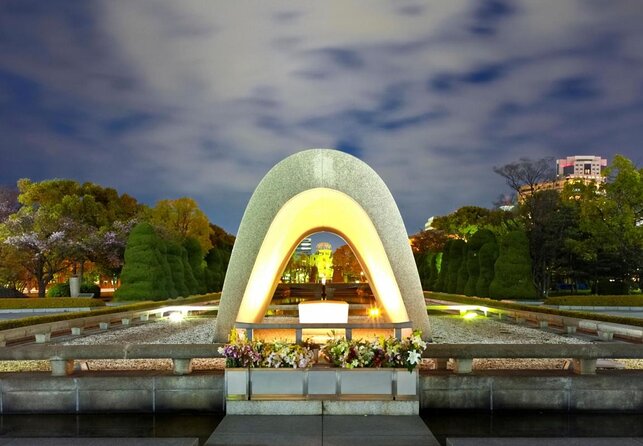
- Small group size (max 10) makes it easier to ask questions and keep the pace human.
- E-bikes for comfort mean you spend more time looking around than powering up hills.
- Entrance fees are included, so you’re not juggling tickets at busy sites.
- Family-linked local guides (you may meet people like Shin, Moe, Moet, Toma, Thomas, or Kana) often add a personal layer you can’t get from a sign.
- A tight, meaningful loop that fits a morning and leaves you the rest of the day free.
Why this 3-hour peace ride fits Hiroshima so well
Hiroshima is a city you can easily over-plan. This tour keeps the focus on what matters most, while still giving you a break from museum-time pacing.
You’re looking at roughly three hours, then you’re back at the start point. That timing is great because you’ll likely want free time afterward—whether that’s wandering the Peace Park area at a slower speed, grabbing lunch, or checking out Hiroshima by yourself.
The value is also in what’s included. At about $85.89 per person, it’s not a “cheap and cheerful” activity. But you’re paying for a local guide, a small-group format, electric bikes, and entrance fees bundled in. Add in bicycle-accident insurance included in the price, and it starts to feel like a well-run way to cover a lot without the hassle.
You can also read our reviews of more tours and experiences in Hiroshima.

Meeting at Hiroshima Peace Memorial Park Rest House and getting set up
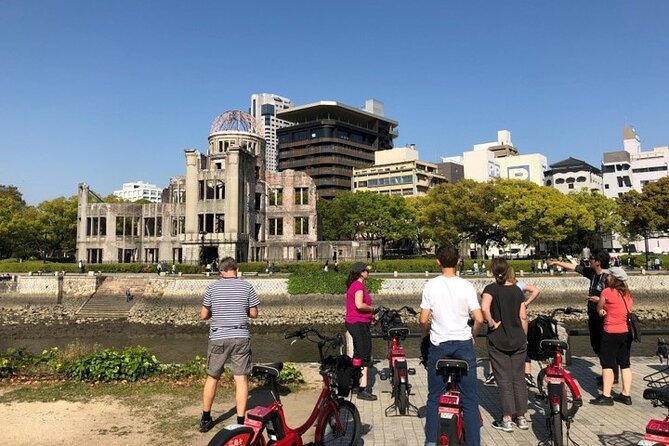
You meet at the Hiroshima Peace Memorial Park Rest House (in the Peace Park area). The tour starts right away with greetings, route explanation, and basic safety steps like temperature checks. The meet-up window is tight, so arrive a few minutes early.
Bikes are part of the experience, and the ride is designed for regular cyclists plus people who want an easier effort. If you’re an adult, you’ll need an adult electric bicycle height requirement of 145 cm or more. Kids have separate options based on size, including smaller bikes (including electric versions within weight/height limits).
Two practical notes that matter:
- You won’t have dedicated luggage storage at the Rest House, so if you’re traveling with bags, plan for nearby coin lockers at the International Conference Center Hiroshima or the Hiroshima Peace Memorial Museum (both within about a 6-minute walk).
- There’s no tour-provided Wi‑Fi, but Hiroshima city free Wi‑Fi is available.
How the ride actually feels (and how the guide keeps you safe)
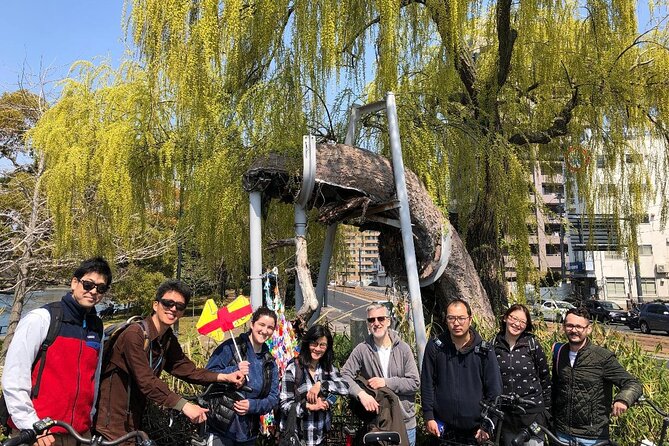
This is a shared tour with up to 10 people, and it includes a “mixed pace” reality: if someone in your group is less used to cycling—especially kids—the guide adjusts. That’s good for comfort, but it also means you should expect small waiting moments while the group regroups.
Electric bikes help a lot. Even in warmer months, e-bikes make the route feel manageable, and several guides are praised specifically for safety awareness and keeping the ride smooth.
The other thing you’ll notice is how the guide sets your attention. You’re not just hopping from one landmark to another—you’re hearing why each place matters, and you’re moving between them at a speed that lets you take in details.
Stop-by-stop: from the Peace Memorial Park to the Atomic Bomb Dome
This route is built to move with meaning. You start in the Hiroshima Peace Memorial Park area, then flow outward and back, hitting the key wartime sites without turning it into a marathon.
Stop 1: Hiroshima Peace Memorial Park (meet and orientation)
You arrive, get a route briefing, and get set with safety info. It’s a short start, but it matters because it frames what you’re about to see.
Stop 2: Hiroshima Castle (the pre-bomb story)
You’ll cycle to Hiroshima Castle, explained as the site connected to the first reporting about the atomic bomb. This stop adds perspective: you’re seeing Hiroshima not only as August 6 aftermath, but as a city with a pre-war timeline and military-era context.
Time on-site is about 20 minutes, with entrance included.
Stop 3: Hiroshima Gokoku Shrine and its gate (what survived)
Next up is Hiroshima Gokoku Shrine and the shrine gate. The focus here is on smaller, often overlooked heritage elements—like the Guardian Dog statue and the gate that withstood the atomic bomb. It’s not just “a building that’s still there.” The guide helps you understand the survival as part of the story.
Entrance fees are included here too, with about 15 minutes.
Stop 4: Chuo Park (a breather of green)
You’ll ride through Chuo Park for about 20 minutes. It’s a pause zone. You get time to notice how Hiroshima rebuilds public space—green and open—without turning the day into constant heaviness.
Stop 5: Aioi Bridge (the target seen in place)
Then comes Aioi Bridge, about a 10-minute stop. This is one of the most important visual anchors on the day: the bridge and river remain, so you can see the place where the bombing’s target story connects to the geography.
Stop 6: Atomic Bomb Dome (the world-famous marker)
About 15 minutes at the Atomic Bomb Dome. This is where you slow down the most. The guide’s job here is to help you read the site beyond its famous status—what local people remember, and how survivors and the wider community understand what it represents.
Entrance is included.
Stop 7: Motoyasu River and the Peace Bridge (history keeps moving)
You then head toward the south side, where you’ll ride along the Motoyasu River and Peace Bridge for about 15 minutes. You get “two readings” at once: the present riverside life and the quiet weight of why this stretch is part of the city’s peace message.
Stop 8: Higashisenda Park (trees from around the world)
At Higashisenda Park, you’ll spend about 20 minutes. It’s filled with trees sent from many countries—plus guide stories tied to the location. If you’ve ever wondered how peace gets built in real-world ways (not just slogans), this kind of living memorial helps answer that.
Stop 9: Atomic Bomb Window Frame Monument / Hiroshima Red Cross Hospital remnants
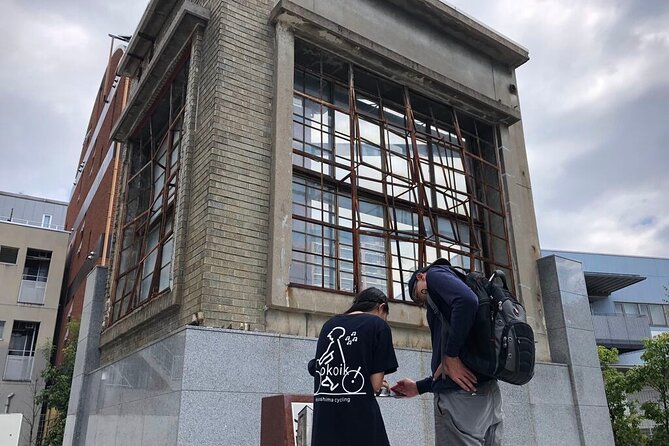
Next is the remnant area connected to the Hiroshima Red Cross Hospital building, including the Atomic Bomb Window Frame Monument. This stop is about reality: you’re seeing physical traces of what the blast did.
Entrance is included. Expect about 20 minutes, and expect it to land hard.
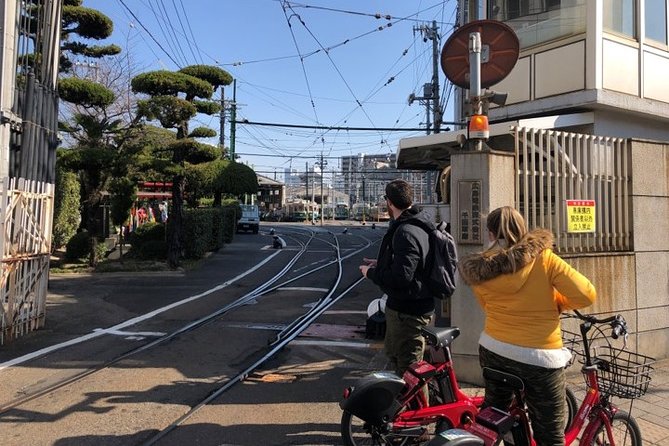
Stop 10: Hiroshima Railway (what survived and still runs)
You’ll visit the Hiroshima Railway area for about 10 minutes. The key detail here is that two trains survived the blast and are still used today, tying the day’s theme to continuity and daily life.
Stop 11: Miyuki Bridge and Kobayashi River (where the reach ended)
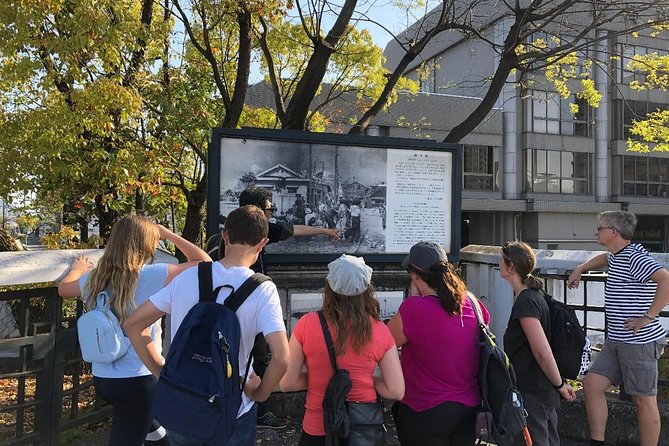
Another 10-minute stop: the Miyuki Bridge and Kobayashi River area, marking where the bombing’s reach ended. There’s also a displayed picture showing the difference between then and now, which helps you understand scale.
Stop 12: Surviving Weeping Willow Tree (a living symbol)
At around 12:40–12:50, the highlight becomes a tree: the Surviving Weeping Willow Tree connected to the Hiroshima Children’s Culture Science Museum area. It’s described as a tree that kept growing despite rumors that natural growth would only be possible for at least 70 years. The guide connects it to strength and endurance.
Stop 13: Peace Boulevard (monuments and the city moving forward)
You’ll pass Peace Boulevard on the way back toward Peace Park. It’s mostly about stitching together what you’ve learned with what you see around you now: monuments, trees, and the fact that Hiroshima is still very much alive.
Stop 14: Return to Hiroshima Peace Memorial Park (the ride ends)
You finish back where you started, around 13:00. The afternoon is yours.
Hiroshima Castle and Gokoku Shrine: seeing pre-war and post-war in one loop
Most peace itineraries focus on aftermath. This one also includes two places that widen the timeline.
At Hiroshima Castle, the guide explains the connection to the first reporting about the atomic bomb. That small detail changes the feeling of the day. You’re not only staring at damage. You’re also learning how information flowed at the moment things shifted.
At Hiroshima Gokoku Shrine, the gate that withstood the blast becomes a kind of “still-standing witness.” These are the stops that tend to feel less obvious than the Dome, but that’s exactly why they add value. You come away with a more complete picture of how memory sits inside the city itself.
Green parks, rivers, and bridges: why the route uses open space
The route repeatedly breaks the heavy stops with spaces like Chuo Park and Higashisenda Park. That’s not random. It’s how the tour keeps you steady.
Along the river and through parks, you can reset your body and eyes. You’re not looking at memorials back-to-back in a constant stare. Instead, you get moments where you can notice urban form—paths, water, trees—then return to meaning right after.
This matters because Hiroshima’s story isn’t just tragedy. It’s also reconstruction, public memory, and the way daily life continues around the marks left behind.
Guides with family stories: why this tour feels personal
The stand-out praise across guides is how personal the stories become. Several guides are described as local descendants of bombing survivors or connected through family memory. Names you might hear include Shin, Moe, Moet, Toma, Thomas, and Kana.
That personal connection is what turns the day from “facts plus photos” into “I understand what people had to live with.” It also helps you process the emotional weight without feeling like it’s being used for shock value.
And it’s not only emotion. Guides are also praised for giving clear explanations, pacing the ride, and staying focused on safety—especially important when you’re biking near other pedestrians and school groups.
One practical plus: your e-bike makes it easier to ask questions as you stop, because you’re not physically spent from cycling.
Practical tips that make the difference on your day
Here are the things I’d plan for based on how this tour is run:
- Arrive early. If you’re late without prior notice, the tour can be canceled and you may face a non-refundable situation. Build in buffer time.
- Bring a layer. Even in sunny weather, you’ll be outside for the whole loop.
- Plan for a “quiet headspace.” This isn’t a party ride. If you want cheerful sightseeing, pair it with a lighter plan after.
- Expect frequent stops. You’ll spend time at each site rather than flying through.
- Use the e-bike. It’s part of what keeps the ride doable, especially in warmer months.
If rain hits, you’re not stuck—there’s a plan. The tour can switch to a rainy-day limited peace route (still starting from Peace Memorial Park and ending earlier), or it can change to a walking tour around the hypocenter area with a smaller radius. You’ll choose what you prefer if the operator offers options.
Who should book this Hiroshima peace cycling tour?
This is a strong fit if you want:
- A guided day focused on war and reconstruction, not just sightseeing.
- An easy-moving route that still hits major memorial sites.
- A small-group experience where you can ask questions and get context tied to real people.
It may be less ideal if:
- You really don’t want to cycle at all. While the operator can switch to walking on rainy days, the standard experience is still a bike tour.
- You’re looking for a purely casual, light tour with minimal emotional content.
Should you book this Hiroshima 3-hour Peace Cycling Tour?
I think you should, especially if you’re on a first visit and want the “right highlights” without doing everything alone. The biggest reasons are practical and emotional at once: small group size, e-bike comfort, and entrance fees handled, plus the fact that guides often share family-linked stories that make the city’s memory feel human.
Book it if you can handle a moving topic and you’re willing to ride for about three hours. Pass if you want something purely recreational or if you’re not comfortable on a bike.
If you want Hiroshima in one meaningful morning—this is the kind of plan that tends to stay with you.
FAQ
How long is the Hiroshima 3-hour Peace Cycling Tour?
It runs for about 3 hours and ends back at the meeting point at Hiroshima Peace Memorial Park Rest House.
How many people are in the group?
It’s a shared tour with a maximum of 10 travelers.
Are entrance fees included?
Yes. Entrance fees are included, so you don’t need to pay on the spot at the stops that require tickets.
What kind of bike will I ride?
You’ll ride an electric bike (adult or child options based on height and other requirements listed for the tour). Bicycles with child seats are limited by weight and height.
What if it rains?
If the plan can’t be held due to rain, you can choose a rainy-day limited peace route option or a walking tour option. If you don’t want the change, a refund is offered.
Is there luggage storage at the Rest House?
There’s no place to leave luggage at the Rest House. The tour notes that coin lockers are available at nearby places like the International Conference Center Hiroshima and the Hiroshima Peace Memorial Museum.