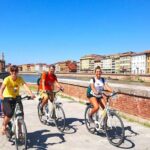
Pisa looks best when you move. This half-day cycling tour with Martina takes you beyond the Leaning Tower into real street life, then drops you right into Piazza dei Miracoli for the big-photo moment. Along the way, you see Pisa’s softer side: bridges, loggias, markets, and the small details that make the city feel lived-in.
I like two things most here: Martina helps you get a bike from a recommended shop, so you are not stuck figuring it out; and the guide’s walk-through at the Field of Miracles puts the Duomo, Baptistery, and Camposanto into a story you can actually remember.
One thing to think about: bike rental rates and the attraction tickets at Piazza dei Miracoli are not included, and the tour depends on good weather and moderate fitness.
In This Review
- Key highlights at a glance
- Why cycling gives you the real Pisa (not just the postcard)
- Price and what it really covers in a 3-hour private tour
- Meeting at Pisa Centrale and handling bikes without stress
- Corso Italia to Ponte di Mezzo: getting your bearings fast
- Borgo Stretto: loggias, Galileo, and small-history clues
- Piazza Giuseppe Garibaldi: students, a grand building, and a carved detail
- Piazza delle Vettovaglie: a Renaissance market square that still works
- Torre del Campano and Palazzo della Sapienza: the town’s older bones
- Piazza dei Cavalieri: power, restoration, and modern schooling
- The Pisan Romanesque stop: the kind of detail you’d miss alone
- Piazza dei Miracoli: Duomo, Baptistery, Camposanto, and timed photo freedom
- Ponte Solferino to Santa Maria della Spina: river views and Gothic finesse
- Keith Haring’s Tuttomondo mural: the surprising modern ending
- Should you book Cycling Pisa highlights & hidden treasures?
- FAQ
- How long is the Cycling Pisa highlights & hidden treasures tour?
- Is this tour private?
- What language is the tour offered in?
- Where does the tour start and end?
- What is included in the price?
- What is not included?
- Does the guide help with bike rental?
- Do I need tickets for Piazza dei Miracoli?
- Is there a photo stop at the Leaning Tower?
- What if the weather is poor?
Key highlights at a glance
- City-cycling focus: Get around Pisa’s key streets and river crossings without a long day of walking
- Bike rental support: Your guide helps you rent a bike at a recommended shop before you roll
- Hidden streets before the monuments: Corso Italia, Borgo Stretto, and market squares set the mood
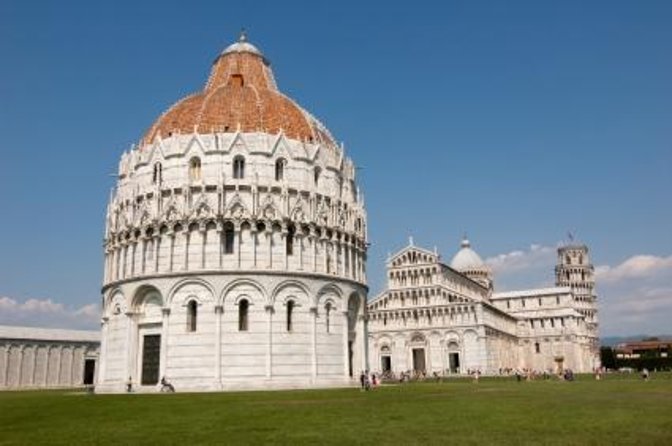
- Piazza dei Miracoli with guidance: Duomo, Baptistery, Camposanto, and the museums are explained, with set time to roam
- Photo time built in: You get a short window for Leaning Tower photos, and you can ask for the best angles
- A modern stop on the Arno: Keith Haring’s Tuttomondo mural adds a surprising finale
Why cycling gives you the real Pisa (not just the postcard)
Pisa is famous for one leaning tower. But if you only aim for that, you miss how Pisa actually works day to day. Cycling changes your pace. You slide through the center quickly, then you slow down where it matters—especially around the monument grounds.
This tour is built for that rhythm. You start with street-level Pisa—shopping lanes, a centuries-old bridge, loggias, and public squares—then you shift gears into the monumental world of the Duomo complex. It feels like two different trips stitched together into one half day, which is exactly what you want if you are short on time in Tuscany.
You can also read our reviews of more tours and experiences in Pisa.
Price and what it really covers in a 3-hour private tour
At $237.26 per person for about 3 hours, this is not a cheap activity. The value comes from the format: it is a private guided tour, just your group, with personal attention. For many people, that matters more than squeezing into a larger tour.
A second piece of the value equation: it is cycling plus guided history. You are not just getting a route; you are getting someone to connect what you see (and where you stand) to how Pisa evolved over centuries.
What to budget separately:
- Bike rental rate (not included)
- Admission tickets at Piazza dei Miracoli (not included)
- Any fees and taxes, plus food and drinks if you stop for them
If you are deciding between a self-guided day and a private guide, this tends to win when you want structure fast—especially around the Field of Miracles, where access and ticketing can eat up time if you handle it alone.
Meeting at Pisa Centrale and handling bikes without stress
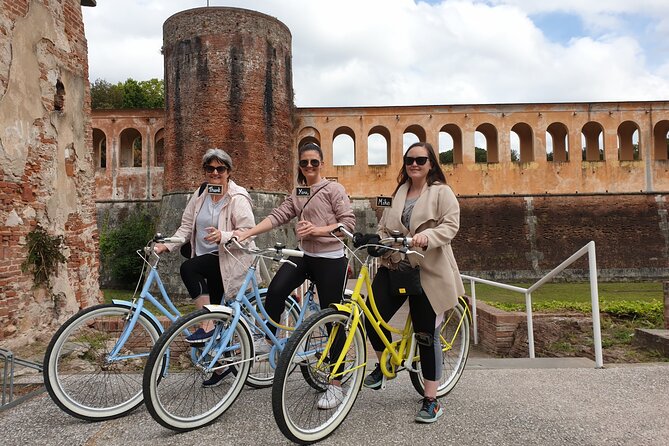
The meeting point is Pisa Centrale, Piazza della Stazione. It is convenient because it puts you near public transport, and it also means you can end back at the same spot when the half day is done.
The practical win: the guide will help you rent a bike at a recommended shop. That single detail saves energy. You avoid the scatter-brain moment of asking multiple places, trying to match your bike to the route, and hoping you got the right size.
Fitness-wise, the tour asks for moderate physical fitness. That does not mean you need to be a racer, but you should be comfortable cycling through city streets and taking short, frequent stops. If you are sensitive to traffic or long stretches on a bike, consider asking the operator what the pace feels like for your group.
Corso Italia to Ponte di Mezzo: getting your bearings fast
You start on Corso Italia, one of Pisa’s main shopping streets. Even if you are not shopping, this is a smart way to begin. It helps you orient quickly, and it shows you how Pisa flows at street level.
Then you reach Ponte di Mezzo, the old bridge that connects Corso Italia with Borgo Stretto. It is a short stop, but it sets a pattern for the tour: Pisa’s river crossing points are often where the city’s identity becomes visible. From here you can feel the layout—where pedestrians move, where the center concentrates, and how the river shapes the streets.
Borgo Stretto: loggias, Galileo, and small-history clues
Next is Borgo Stretto, a charming street defined by two Renaissance loggias—one on each side. Loggias are not just pretty architecture. They are practical spaces where people moved, traded, met, and sheltered from sun and rain.
This area also brings in the Galileo link, since his home is part of the story here. Martina is the kind of guide who points out the clues you would otherwise walk right past: why the loggias matter, what the facades are telling you, and how the Renaissance shaped daily life in this part of town.
Piazza Giuseppe Garibaldi: students, a grand building, and a carved detail
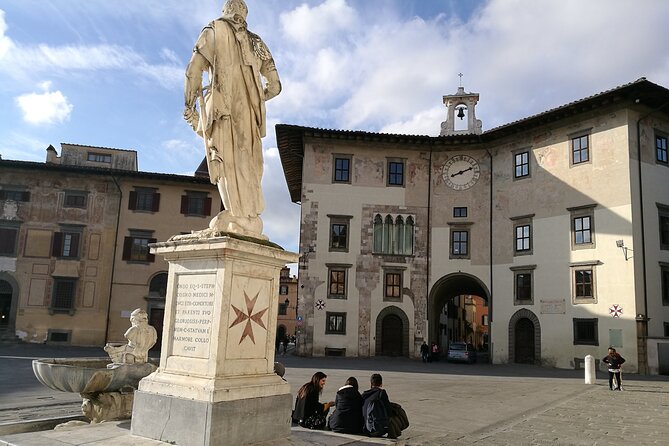
In Piazza Giuseppe Garibaldi, you get a break in the movement with a clear public square feel. It is known for gathering students, and it features the Casino dei Nobili, an eighteenth-century building. Garibaldi’s statue sits at the center, so even if you miss everything else, you have a visual anchor.
There is also a detail that sounds almost too specific to remember later: a wooden carving called Madonna dei Vetturini hanging at the edge of the Renaissance loggia. The point of this stop is not the name alone. It is that Martina’s explanations turn random surfaces into “oh, that’s why it’s there.”
Piazza delle Vettovaglie: a Renaissance market square that still works
At Piazza delle Vettovaglie, you encounter another piece of living Pisa: this Renaissance market square (vegetables and fruits). The market runs every morning, and the tour notes it also continues in the adjoining St. Omobono square.
If you love cities that still do day-to-day things, this stop is a relief. It is not only monuments. It is people buying produce, talking, and moving through the same public spaces that have served practical needs for a long time.
Even if the market is smaller when you visit, the square still gives you a sense of scale and texture before the big-ticket sights.
Torre del Campano and Palazzo della Sapienza: the town’s older bones
Torre del Campano is quick but memorable: it is the only medieval tower still standing in town. That kind of survival makes a stop worth it. You are not just looking at a structure—you are seeing something that outlasted the centuries.
Then you move to Palazzo della Sapienza, which has a layered identity. It used to be the Piazza del Grano, the wheat market square. Later, it became part of the Studio Pisano, the early University of Pisa, by the end of the fifteenth century. Today, it reflects nineteenth-century architecture with a Renaissance courtyard.
This stop helps you understand Pisa beyond the Field of Miracles. The city was a center for learning and civic life, not just a backdrop for famous buildings.
Piazza dei Cavalieri: power, restoration, and modern schooling
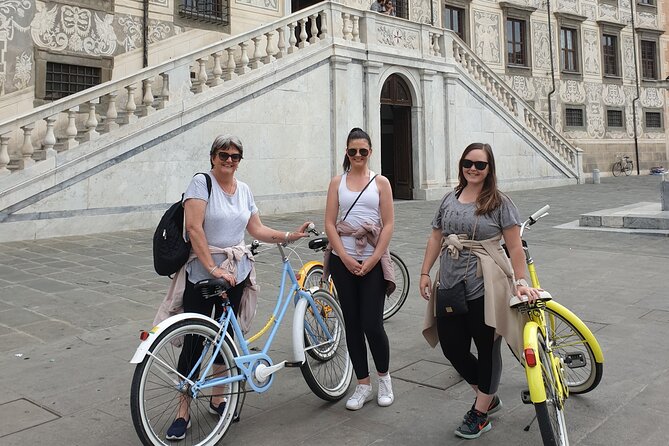
Piazza dei Cavalieri is where Pisa’s political center energy comes through. It was once Piazza delle Sette Vie and served as the political center until the sixteenth century.
It was restored on behalf of Cosimo I and later turned into the headquarters of the Knights of Saint Stephen. Today, the square hosts the Scuola Normale Superiore.
So you see a full loop:
- civic power
- religious-knightly identity
- educational presence
Martina’s approach here is useful because she helps you connect the changes in rulers to the way the buildings function. If you like seeing how politics leaves physical marks, this is one of the more satisfying transitions on the ride.
The Pisan Romanesque stop: the kind of detail you’d miss alone
At one point, you also stop at a Pisan Romanesque building known for unusual decoration on the front and sides. The tour highlights this because Martina points out what to look for.
This is the value of a guided cycle: you are not just ticking off major sights. You are catching the decorative quirks that make Pisa feel distinctive. In towns like this, the famous monuments get most of your attention. A guide helps you still appreciate what makes the rest of the city worth your time.
Piazza dei Miracoli: Duomo, Baptistery, Camposanto, and timed photo freedom
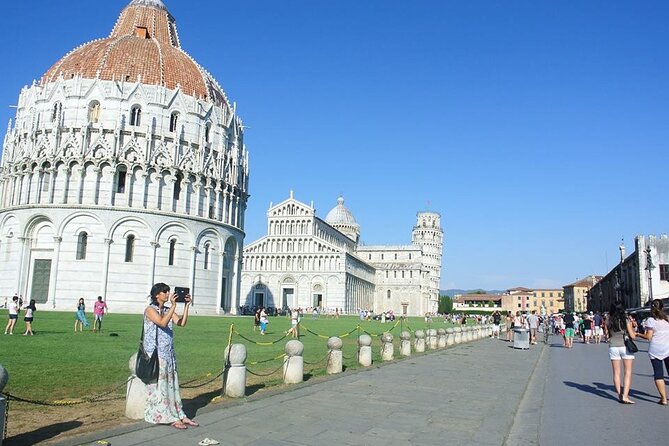
Now you hit the main event: Piazza dei Miracoli. This is the world-famous square that ties together the Duomo, Baptistery, Leaning Tower, Camposanto, and related sites like the Museum of Sinopie and the Museum of Opera del Duomo.
This section runs about 1 hour 15 minutes, and it includes free time within that window (not counting the guided explanation). The attraction tickets for this stop are not included, so plan to cover admission separately.
Why the guided approach matters here:
- Martina provides the history, legends, and traditions tied to the complex
- You get help spotting the meanings behind the buildings, rather than only seeing the surfaces
- You are not stuck wondering which angle gives you the best Leaning Tower shot
You also get a short 10-minute photo window for Leaning Tower pictures, and there is a mandatory photo included at the tower. If you want better results than the standard standing-straight option, ask Martina for the best angles. She will guide your positioning for photos so you do not spend the best light fighting perspective.
One practical note: this is the most time-pressured part of Pisa. If you have strong preferences about which museum to add or how long you want around the monuments, talk it through early so the schedule fits your priorities.
Ponte Solferino to Santa Maria della Spina: river views and Gothic finesse
After Piazza dei Miracoli, you shift from stone grandeur to river-side beauty.
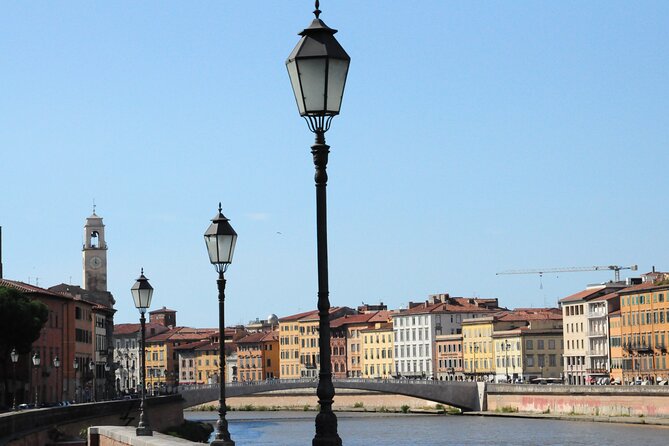
At the top of Ponte Solferino, you get a strong viewpoint over the Lungarni and toward the Guelfa Tower, the Medici Arsenals, and the Medieval Terzana area. Even a five-minute stop works here because it gives you a spatial map. You see how the Arno and the city connect, which makes the earlier walking streets feel less random.
Then you visit Chiesa di Santa Maria della Spina, described as a Gothic jewel along the left bank of the Arno. It is a short stop, but the payoff is the contrast: after major Romanesque and monumental sites, you see how Pisa also used Gothic style to create a more delicate, almost jewelry-like presence.
If you like architecture that rewards close looking, take your time here even though the stop is brief. This is where you can slow down without feeling like you are wasting precious time.
Keith Haring’s Tuttomondo mural: the surprising modern ending
The final stop is Murale Tuttomondo di Keith Haring, titled Tuttomondo (1989). The mural is 180 square meters with 30 figures and symbols—an outdoor work by an American underground artist known for messages of peace, love, and tolerance.
It is a fun wrap-up for a tour that starts with medieval towers and university-era squares. After you’ve spent hours with old stone and carved detail, you get one last hit of modern visual storytelling on a wall.
This is also a good moment to reset your energy. By the time you reach the mural, you have already done the heavy viewpoint work. Now you can enjoy the art without rushing to fit in another landmark.
Should you book Cycling Pisa highlights & hidden treasures?
I’d book this tour if you want:
- a half-day plan that covers both the city streets and the Field of Miracles area
- a private guide who can tailor the pace for your group
- a cycling format that helps you see more than walking alone in limited time
I would hesitate if:
- you expect everything to be fully included (bike rental and Piazza dei Miracoli admission are not included)
- you are uncomfortable with moderate physical effort
- weather is questionable, since the experience requires good conditions
One last practical tip: if you care about inside access around Piazza dei Miracoli, budget for tickets ahead of time and leave room in your thinking for the tour’s timing. This is a smooth route, but the monument complex is where you will feel the schedule most.
If that sounds like your kind of day, you will probably love the way Martina connects Pisa’s big monuments with the smaller streets that make the city feel like a real place, not a museum set.
FAQ
How long is the Cycling Pisa highlights & hidden treasures tour?
It lasts about 3 hours.
Is this tour private?
Yes. It is a private tour/activity, and only your group participates.
What language is the tour offered in?
The tour is offered in English.
Where does the tour start and end?
It starts at Pisa Centrale, Piazza della Stazione, and ends back at the same meeting point.
What is included in the price?
The tour includes a 3-hour private guided tour of Pisa. You’ll also get a mobile ticket.
What is not included?
Bike rental rate, admission tickets (including at Piazza dei Miracoli), all fees and taxes, lunch, and personal expenses are not included.
Does the guide help with bike rental?
Yes. The guide will help you rent a bike at a recommended shop.
Do I need tickets for Piazza dei Miracoli?
Admission tickets for Piazza dei Miracoli are not included, so you should plan to purchase them separately.
Is there a photo stop at the Leaning Tower?
Yes. There is time for photos at Piazza dei Miracoli, and there is a mandatory Leaning Tower photo within that portion. You can ask Martina for the best angles.
What if the weather is poor?
The experience requires good weather. If it’s canceled due to poor weather, you’ll be offered a different date or a full refund.